Positive psychology shifts the traditional focus from repairing what is wrong with people to understanding strengths and building what makes life worth living. Instead of concentrating on illness, dysfunction, and mental disorders, positive psychology studies the strengths, virtues, positive emotions, relationships, and life experiences that contribute to human flourishing and well-being.
Earlier humanistic thinkers like Abraham Maslow touched on ideas similar to Positive Psychology, the field coalesced into a formal scientific movement in the late 1990s with Martin Seligman. As president of the American Psychological Association in 1998, Seligman argued that psychology should balance its traditional emphasis on pathology with a scientific focus on well-being, strengths, and optimal functioning.
Seligman and his colleagues articulated that well-being can not only be defined and measured but also taught and cultivated. This marked a paradigm shift, psychology would no longer look only at what makes people suffer, but also at what helps them thrive and experience the “good life.”
Defining Positive Psychology
Positive psychology is best described as:
The scientific study of what makes life most worth living, exploring strengths, positive experiences, and conditions that enable individuals, communities, and systems to flourish.
Positive psychology focuses on building assets, such as resilience, hope, optimism, compassion, and a sense of meaning.
Topics in the field include:
- Positive emotions (joy, gratitude, hope)
- Character strengths and virtues
- Engagement and flow states
- Deep, supportive relationships
- Meaning and purpose
- Accomplishment and self-actualization
- Well-being in institutions and communities
The PERMA Model of Well-Being
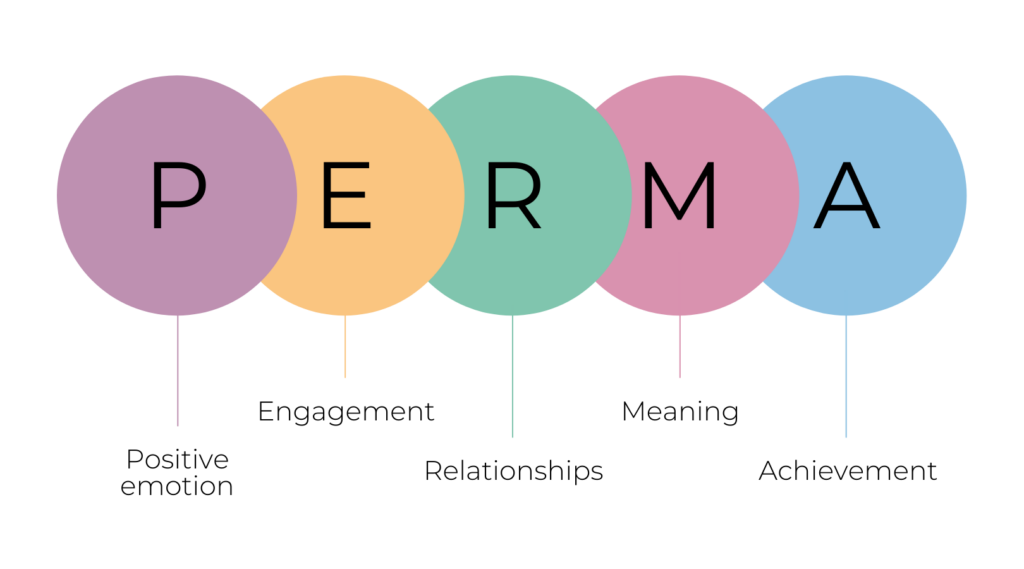
One of the most influential frameworks in positive psychology is Seligman’s PERMA model, which outlines five fundamental elements that contribute to human flourishing:
- Positive Emotion – Experiencing joy, pleasure, and comfort.
- Engagement – Being deeply immersed in activities that match one’s strengths (often experienced as flow).
- Relationships – Building and sustaining supportive, meaningful connections.
- Meaning – Having a sense of purpose that connects you to something larger than yourself.
- Accomplishment – Achieving goals, mastering skills, and feeling a sense of success.
These elements work independently and interactively to compose a holistic picture of well-being. The model recognizes that different people derive well-being in different ways; flourishing for one individual may not look identical for another.
Flow and Engagement
Closely related to PERMA’s engagement component is the concept of flow, developed by psychologist Mihaly Csikszentmihalyi. Flow describes the state of being fully absorbed in a task—where time seems to fade away and one experiences intense focus and intrinsic enjoyment. Engaging in flow activities enhances life satisfaction and contributes significantly to subjective well-being.
Beyond Feelings: Science and Evidence
Positive psychology is grounded in scientific research. Numerous studies demonstrate that cultivating strengths and positive experiences has real, measurable benefits, including:
- Improved physical health and immune function
- Better performance at school and work
- Greater resilience and coping skills
- Stronger social bonds
- Longer life expectancy
- Lower burnout and stress levels
Importantly, the field does not advocate ignoring negative emotions. Rather, it acknowledges that well-being includes a full range of human experiences, and that recognizing both positive and difficult experiences contributes to a richer, more resilient life.
Applications in Everyday Life
Positive psychology has practical implications across multiple domains:
- Education: Teaching students skills for resilience, engagement, and growth.
- Therapy: Shifting some focus from dysfunction to strengths and meaning.
- Workplaces: Enhancing employee well-being and performance.
- Communities: Designing systems that foster connection, purpose, and social support.
People intentionally apply positive psychology techniques, such as gratitude journaling, identifying and using signature strengths, mindfulness, and fostering supportive relationships, to enrich their daily lives and amplify their sense of fulfillment.
A Balanced Perspective
While positive psychology has revolutionized how researchers and practitioners think about human flourishing, it also faces critiques, such as potential cultural bias or over-emphasis on individual responsibility for well-being. But as the field matures, it continues to refine its methods and balance enthusiasm for positive change with scientific rigor.
Positive psychology offers a comprehensive, research–based framework for understanding well-being. By studying and cultivating the conditions that make life deeply satisfying (positive emotions, engagement, strong relationships, meaning, and accomplishment) individuals and communities can move beyond merely surviving to truly flourishing
Sources: https://www.psychologytoday.com/us/basics/positive-psychology , https://ppc.sas.upenn.edu/learn-more/perma-theory-well-being-and-perma-workshops , https://www.neh.gov/article/martin-seligman-and-rise-positive-psychology , https://pmc.ncbi.nlm.nih.gov/articles/PMC6124958/ , https://positivepsychology.com/what-is-positive-psychology-definition/